Joshua Tree: Skull Rock
GuidesJoshua Tree: Skull Rock
The Ultimate Guide To

Skull Rock, Joshua Tree National Park

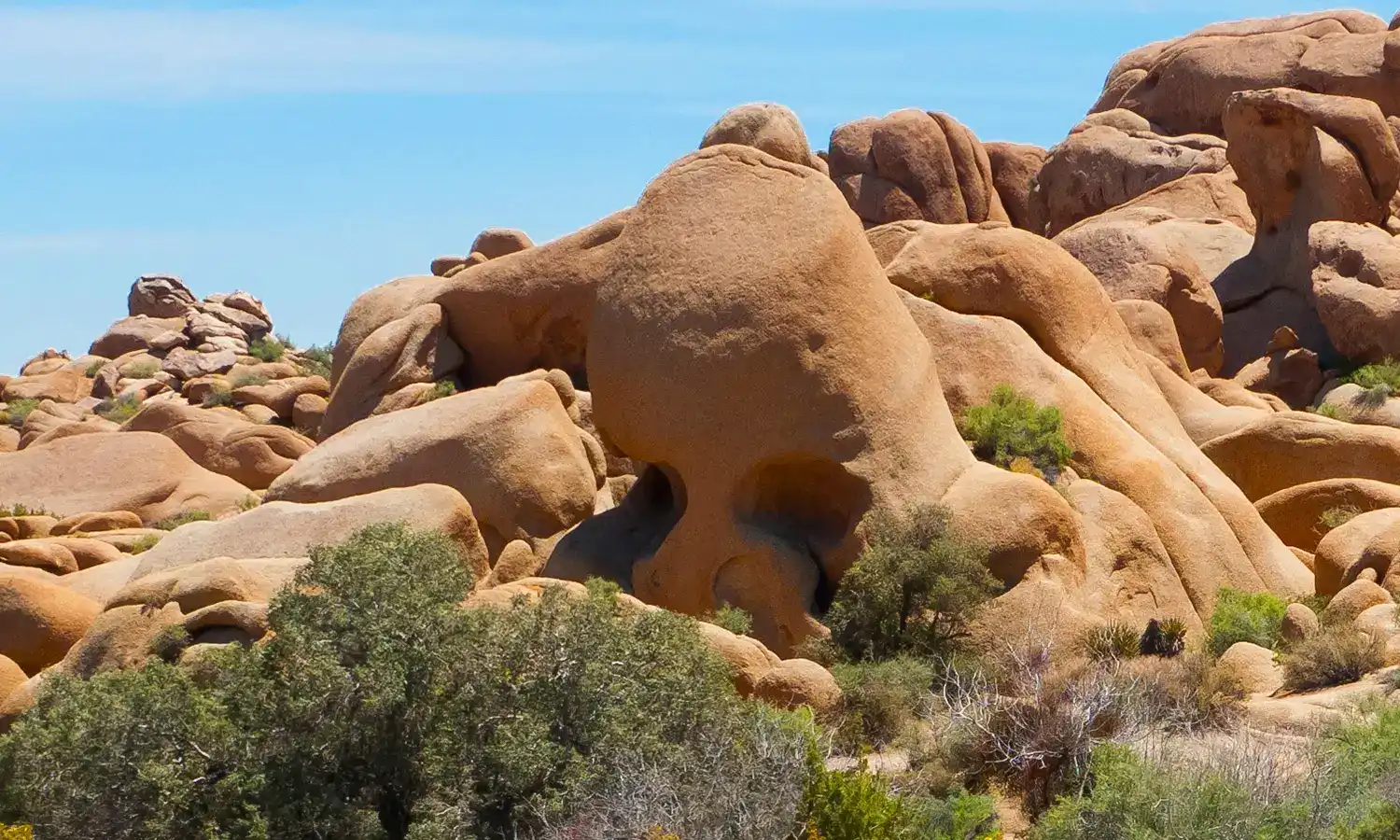
A granite formation 25 feet tall, shaped by millions of years of weathering in the Mojave Desert.

At a glance
  • Skull Rock sits along the Jumbo Rocks area of Park Boulevard and is reachable via a short 1.7 mile nature trail loop starting at the Skull Rock trailhead
  • The rock formation gets its name from two large erosional pockets near the top that resemble eye sockets, shaped over time by wind and water wearing away the softer granite
  • Fall and spring offer the most comfortable temperatures for hiking, with daytime highs typically staying below 85°F
  • Arrive early in the morning to catch the best light on the rocks and to beat the crowds that build up by midday on weekends
  • The trail is relatively flat and family friendly, passing through classic Mojave Desert scenery including Joshua trees, creosote, and scattered boulder piles

Skull Rock sits just off the main park road in Joshua Tree National Park, where the Mojave and Colorado Desert ecosystems meet. The formation rises about 25 feet from the desert floor, its weathered granite surface pocked with two deep hollows that give it the face-like appearance visitors recognize from miles away.

Standing here, you notice the scale of things quickly. Joshua trees spread across the flats in every direction, their spiky crowns reaching 15 to 40 feet into the sky depending on age. Creosote bushes fill the gaps between rocks and trees, their small waxy leaves releasing a sharp resinous smell after rain that many people associate with the desert Southwest more than any other scent. The rock itself is warm to the touch in the afternoon sun, rough-grained and pale pink-gray against the wide blue sky.

Wildlife moves through this area throughout the day. Desert cottontails pause in the shade of boulders with ears up, reading the air for sound. Lizards cross the sandy soil between shrubs. Cactus wrens call from the Joshua trees while ravens work the thermals overhead.

The light changes the whole scene depending on when you visit. Morning brings cool shadows across the rock face and softer colors across the landscape. Late afternoon turns the granite orange and deepens the contrast between the pale soil and dark shrubs. At midday the sun flattens everything out and the heat radiates up from the ground in visible waves.

This is a short walk from the road, accessible to nearly anyone.

The Visit

Visiting Skull Rock, Joshua Tree

Getting there

Skull Rock sits just off Park Boulevard in the Jumbo Rocks area of Joshua Tree National Park, roughly 5 miles west of the town of Twentynine Palms. Pull into the Skull Rock trailhead parking area on the south side of the road and the formation is visible almost immediately from the lot. A short, flat walk of under a quarter mile puts you right at the base.

When to go

Winter and early spring offer the most comfortable temperatures and the clearest light. The formation faces generally east, so sunrise is when the low angled light hits the weathered surface directly and brings out the texture in the rock. Golden hour in the evening wraps the surrounding boulders in warm tones worth sticking around for. Midday sun in summer is harsh and the heat can be punishing so plan accordingly.

What to look for

Keep an eye out for the dark circular depressions worn into the granite surface called tafoni, where wind and moisture have slowly hollowed out pockets over thousands of years. Creosote bushes grow low and sparse around the base and after rain they release a distinct resinous smell that defines the Mojave. Desert cottontails are common in this area, often sitting still near the boulder edges with ears raised, relying on stillness rather than speed as their first line of defense.

Joshua Tree: Skull Rock
Find it

Joshua Tree: Skull Rock

Earned the hard way

Insider Tips

01

Walk the nature trail east for a quieter shot

Most visitors pull into the parking area, photograph Skull Rock from the front, and leave. If you continue east along the Skull Rock Nature Trail past the main formation, the boulder piles thin out and you get wider compositions that place the rock in context with the surrounding Joshua trees and open desert floor. Early morning works especially well here because the low sun angles across the tafoni pockets and brings out the texture in the granite surface in a way that midday light flattens completely.

02

Wear low trail runners and a wide-brim hat

The nature trail mixes packed sand, loose gravel, and patches of uneven rock that can turn an ankle in stiff boots. Low-profile trail runners give you enough grip for the minor rock scrambling around the formations without the bulk. More importantly, there is almost no shade on this trail at any point in the day, so a wide-brim hat is not optional gear here. The desert sun reflects off the pale granite and you feel it from multiple directions at once.

03

Stop at Frontier Café in Yucca Valley on the way in

Yucca Valley sits right on Highway 62 between the LA metro area and the park's west entrance, making it a natural first stop. Frontier Café at 55844 Twentynine Palms Hwy serves scratch-made breakfast and lunch alongside locally roasted organic coffee, and it opens at 7am daily so you can fuel up before the trailhead parking fills. Grab something to take with you because there is no food or water inside the park once you pass the entrance station.

Lace up

Nearby Hikes

Trails worth your time when you're in the area.

hard

Ryan Mountain Trail

2.9 mi/1,062 ft gain

Ryan Mountain is the most popular summit hike in the park and sits about 10 miles west of Skull Rock along Park Boulevard. The trail climbs steadily from the trailhead at roughly 4,300 feet, gaining over 1,000 feet to the 5,461 foot summit. The ascent is relentless and rocky but the path is well worn and easy to follow. From the top you get a 360 degree view across the Mojave that takes in the Pinto Basin, the Little San Bernardino Mountains, and a wide sweep of boulder fields and desert flats. Plan for 2 to 2.5 hours and bring more water than you think you need.

View on alltrails.com
easy

Split Rock Loop

2.5 mi/308 ft gain

Split Rock sits just a few minutes east of Skull Rock off Park Boulevard and shares a similar landscape of piled granite boulders and open desert. The 2.5 mile loop winds through rock formations, sandy washes, and clusters of Joshua trees with minimal elevation gain. A short spur takes you to Face Rock, a formation worth the detour. The trail can be faint in spots so keeping an eye on the path helps. It draws fewer crowds than Skull Rock while offering comparable scenery.

View on alltrails.com
easy

Barker Dam Trail

1.3 mi/65 ft gain

Barker Dam is one of the most visited short hikes in the park and sits about 12 miles west of Skull Rock near Hidden Valley. The nearly flat 1.3 mile loop passes through granite boulder corridors and open desert before arriving at a small reservoir built by cattle ranchers in the early 1900s. After rain the dam holds water and draws bighorn sheep and shorebirds to the edge. A rock art site on the return leg adds a layer of human history to the walk. Check current NPS conditions before visiting as the trail has seen periodic closures.

View on alltrails.com
easy

Hidden Valley Trail

1 mi/114 ft gain

Hidden Valley sits about 15 miles west of Skull Rock and is one of the first major stops most visitors make after entering the park from the west. The one mile loop circles through a flat enclosed basin ringed by tall granite walls that once sheltered livestock from view. The rock climbing here is some of the most accessible in the park and you can often watch climbers working the faces above the trail. Interpretive signs identify plants along the route making it a solid introduction to Mojave Desert ecology for first time visitors.

View on alltrails.com
easy

Arch Rock Trail

1.4 mi/56 ft gain

Arch Rock is a short lollipop style hike located near White Tank Campground on Pinto Basin Road about 5 miles south of Skull Rock. The mostly flat sandy trail passes through open desert and scattered boulders before arriving at a small natural granite arch formed by the same weathering processes that shaped Skull Rock. The surrounding rock scrambling makes it a natural extension of a Skull Rock visit and the two trailheads are close enough to do both in one morning. Park at the Twin Tanks trailhead on Pinto Basin Road.

View on alltrails.com
Support the park

Joshua Tree National Park Hat

100% of the profit from every hat goes straight to the National Parks. Not a round-up. Not a percentage. The whole margin.

Shop this hat

Joshua Tree National Park Hat
Why it matters

Protecting Joshua Tree

Joshua Tree National Park protects a rare overlap of two desert ecosystems, the Mojave and the Colorado, and Skull Rock sits at the heart of that transition zone. The geological processes that shaped this formation took millions of years and cannot be replicated once disturbed. Biological soil crust around the base of these rocks, the thin living layer of mosses, lichens, and cyanobacteria that holds desert soil in place, takes decades to recover from a single footstep off the path. Protecting places like this means future visitors can observe the same natural processes at work rather than inheriting a degraded version of the landscape.

Rainier Hat Co. was built around the idea that outdoor gear can do more than outfit a trip. Every hat we sell acts as a direct funding vehicle for the parks, and the Joshua Tree National Park Hat is no exception. One hundred percent of the profit from each hat goes straight to the National Parks. It is not a donation round-up at checkout or a percentage of sales. It is the whole margin, directed to the places that matter.
Frequently Asked Questions

Where is Skull Rock located in Joshua Tree National Park?

Skull Rock sits along Park Boulevard in the Jumbo Rocks area of Joshua Tree National Park, near the intersection with Pinto Basin Road. The pullout and trailhead are clearly marked and easy to find if you're driving through the park from the west entrance.

How do I get to Skull Rock?

From the town of Twentynine Palms, take Utah Trail south into the park and follow Park Boulevard west. The Skull Rock pullout is on the south side of the road, about 4 miles in from the north entrance. From the west entrance near Joshua Tree village, it's roughly 16 miles east on Park Boulevard.

Is there a trail at Skull Rock?

Yes. The Skull Rock Nature Trail is a 1.7 mile loop that begins at the Skull Rock pullout and winds through the Jumbo Rocks area. It passes several interesting rock formations and desert plants with interpretive signs along the way.

How long does it take to hike the Skull Rock Nature Trail?

Most people complete the loop in about 45 minutes to an hour at a relaxed pace. If you stop to read the interpretive signs or explore the rocks, plan for closer to 90 minutes.

Is the Skull Rock trail difficult?

The trail is considered easy to moderate. The terrain is mostly flat with some sandy sections and minor rock scrambling around the formations. It is suitable for most fitness levels and older children who are comfortable walking on uneven ground.

Why does Skull Rock look like a skull?

Two large weathered pockets near the top of the rock resemble eye sockets, giving it a skull-like appearance when viewed straight on. These depressions form through a process called weathering, where water collects in small cracks, dissolves minerals in the granite, and gradually hollows out the rock surface over thousands of years.

What type of rock is Skull Rock made of?

Skull Rock is composed of monzogranite, a coarse-grained igneous rock that formed deep underground from slowly cooling magma. Over millions of years, erosion removed the overlying material and exposed these formations at the surface.

What is the weathering process that shaped Skull Rock?

The rounded shape comes from a process called spheroidal weathering. Groundwater works along joints and fractures in the granite, eroding the corners and edges faster than the flat surfaces. Over time the blocky rock takes on a rounded, almost sculpted appearance. The pockets and hollows form separately through a process called tafoni, where moisture and salt work to erode softer sections of the rock face.

Is there parking at Skull Rock?

There is a dedicated pullout and small parking area directly at the Skull Rock trailhead on Park Boulevard. It fills up quickly during peak hours so arriving early in the morning or later in the afternoon improves your chances of finding a spot.

Is Skull Rock accessible for people with mobility limitations?

The area immediately around Skull Rock involves uneven rocky terrain and is not paved. The full nature trail is not wheelchair accessible. Visitors who need a flat surface may have difficulty getting close to the rock itself, but it is visible from the parking area.

Can you climb on Skull Rock?

Climbing directly on Skull Rock is discouraged by the National Park Service to protect the formation and the biological soil crust around the base. Joshua Tree does have designated climbing areas throughout the park, but Skull Rock is considered a scenic and interpretive site rather than a climbing destination.

What is the best time of day to visit Skull Rock?

Early morning and late afternoon offer the most comfortable temperatures and the best light for photography. Midday in summer can be extremely hot and the parking area tends to be most crowded between 10am and 2pm.

What is the best time of year to visit Skull Rock?

October through April is generally the most comfortable time to visit. Spring wildflower season from late February through April can be particularly rewarding. Summer temperatures regularly exceed 100 degrees Fahrenheit so heat preparedness is essential if you visit between June and September.

Is there shade at Skull Rock?

There is very little shade in the immediate area. The desert landscape is open and exposed so a hat, sunscreen, and plenty of water are necessary regardless of the season.

How much water should I bring to Skull Rock?

For the 1.7 mile nature trail, bring at least one liter of water per person. In warmer months carry more, at least two liters per person. There is no water available at the trailhead so fill up before entering the park.

What wildlife might I see near Skull Rock?

Desert cottontails are commonly spotted around the rock formations, especially in the morning. You may also see lizards such as the common side-blotched lizard, ravens, cactus wrens, and various sparrow species. Coyotes move through the area, typically in the early morning or at dusk.

Are there rattlesnakes near Skull Rock?

Rattlesnakes do live in Joshua Tree National Park including the Jumbo Rocks area. They are most active in warmer months, especially at dawn and dusk. Watch where you step and never reach into rock crevices or brush without looking first.

Are dogs allowed at Skull Rock?

Dogs are allowed at Skull Rock and on the nature trail but must be kept on a leash no longer than six feet at all times. Be aware that the hot pavement and rocky ground can damage paw pads in summer heat and dogs are not permitted on most trails in the backcountry.

Is there a fee to visit Skull Rock?

Skull Rock is inside Joshua Tree National Park which charges an entrance fee. As of 2024, the fee is $35 per vehicle for a seven day pass. An America the Beautiful annual pass covers entrance to all national parks and is a good value if you visit multiple parks in a year.

Are there restrooms near Skull Rock?

Vault toilets are available at the Jumbo Rocks Campground, which is located just a short drive from the Skull Rock pullout. There are no flush toilets or running water at this location.

Can I camp near Skull Rock?

Jumbo Rocks Campground sits less than a mile from Skull Rock and offers 124 campsites. It is one of the more popular campgrounds in the park because of its proximity to rock formations and the nature trail. Reservations are recommended from October through May.

What plants will I see on the Skull Rock Nature Trail?

The trail passes through classic Mojave Desert vegetation including Joshua trees, creosote bush, black-tailed cholla, beaver tail cactus, and various desert shrubs. Interpretive signs along the route identify many of these plants and explain how they survive in the desert environment.

Is Skull Rock worth visiting?

For most visitors to Joshua Tree, yes. The short walk is manageable for a wide range of ages and fitness levels and the rock itself is a clear example of the geologic processes that shaped the park. It works well as a quick stop along Park Boulevard or as part of a longer exploration of the Jumbo Rocks area.

How crowded does Skull Rock get?

Skull Rock is one of the most visited spots in Joshua Tree and can feel quite busy on weekends and holidays, particularly from November through April. Weekday mornings tend to be noticeably quieter. If solitude is important to you, consider pairing it with a longer hike deeper into the park.

What else is there to do near Skull Rock?

The Jumbo Rocks area offers plenty to explore beyond Skull Rock. The Skull Rock Nature Trail itself connects to additional informal paths among the boulders. Jumbo Rocks Campground is nearby, and the Geology Tour Road is a short drive south and offers a deeper look at the park's rock formations by vehicle or mountain bike.